
18 Indian-flagged vessels with 485 Indian seafarers still remain in the western Persian Gulf region

Elevated global crude oil and natural gas prices, driven by geopolitical developments in West Asia, could significantly influence the Government of India's fiscal position for 2026-27, according to a report by ratings agency Icra.

Around one full month of supply is firmly arranged with additional procurement being continuously finalised, and oil companies are successfully delivering over 5 million cylinders every day.

'Refiners may soon be forced to adjust operations, curtailing runs as product exports stall and directing output solely to domestic markets.'

24 Indian-flagged vessels with 677 Indian seafarers were currently located west of the Strait of Hormuz, and four vessels with 101 Indian seafarers were stationed east of the strategic waterway.

If the conflict continues for a prolonged period, State-run oil companies may have to review retail fuel prices accordingly.

Adani group on Tuesday announced a $100 billion investment to develop hyperscale, artificial intelligence (AI)-ready data centres powered by renewable energy by 2035. The initiative is expected to catalyse an extra $150 billion in investment across server manufacturing, electrical infrastructure, Cloud platforms, and supporting industries over the next decade.

Private-sector oil refiner Reliance Industries Limited (RIL) last week received a general licence from the United States (US) government to buy Venezuelan oil, an industry executive said.
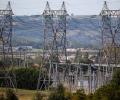
The government on Wednesday put out the draft of a new policy that projects the country's power sector will need Rs 50 trillion in investments by 2032 and Rs 200 trillion by 2047, proposing ambitious reforms in generation, transmission and distribution.

'The immediate impact for India will be very minimal as the share of Venezuela in our total overseas production is very low.'

The operator's liability in the case of an incident is limited to 3,000 crore for reactors with thermal power above 3,600 Megawatt; 1,500 crore for reactors with thermal power between 1,500 Mw and 3,600 Mw; 750 crore for reactors with thermal power between 750 Mw and 1,500 Mw; 300 crore for reactors with thermal power between 150 Mw and 750 Mw; and 100 crore for reactors having thermal power up to 150 Mw, fuel cycle facilities other than spent fuel reprocessing plants and transportation of nuclear materials.
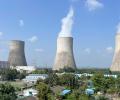
The Bill is likely to pave the way for amending two existing legislations -- the Atomic Energy Act 1962, and the Civil Liability for Nuclear Damage Act 2010.

After four failed reform drives, a new plan aims to rescue India's debt-laden power discoms through privatisation, accountability and long-term financial fixes.

'At COP30, the emphasis will be on unlocking climate finance, reinforcing the principle of common but differentiated responsibilities, and building resilience through inclusive transitions and the mainstreaming of adaptation.'

CERC, which has a key role in India's power sector, has also set up a committee to gather further evidence in the matter and take suitable action.
The ambitious proposal by the power ministry to allow network sharing between distribution licensees operating in the same geographical area will face three key challenges, said a former bureaucrat.
The idea is to establish a robust and forward-looking legal framework that addresses the financial stress of power distribution companies, which are facing losses of over 6.9 trillion, while curbing high industrial tariffs that, according to the government, have affected competitiveness, constrained economic growth, and slowed the transition to clean energy.

To prevent companies from submitting unrealistic quotes to bag project contracts across industries, the government is planning to soon roll out a mechanism to curb irrational bidding.

'Both initiatives are welcome moves and we would commit ourselves with focused attention aligned with the national priorities, and pursue our exploration initiatives.'

India's traditional companies are now moving full scale into the renewable and alternative energy space that had been dominated by smaller players over the past decade. Companies such as government-owned NTPC and the Adani and the Tata groups restructured their businesses well in time to become major players in the green space. At the same time, other conventional companies, such as Larsen & Toubro and Reliance Industries Ltd (RIL), which have a presence both in the energy sector as well as myriad other activities - construction, technology and retailing - are tying up with new-age companies to hitch a ride to a greener path.
 © 2026 Rediff.com - Advertise with us - Disclaimer - Privacy Policy - Sitemap - Feedback - About us - Terms of use - Grievances